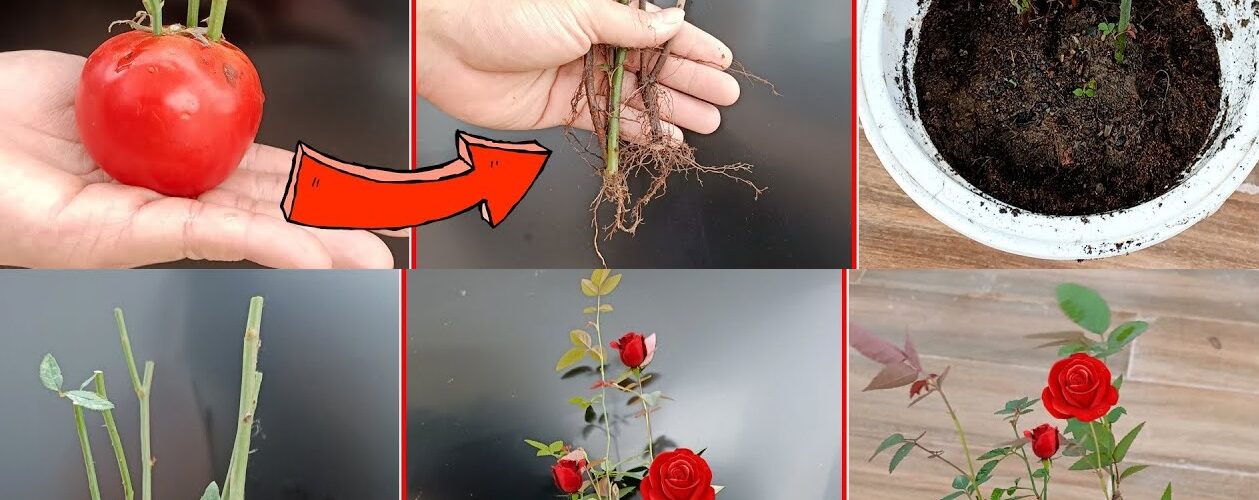
If you want to propagate your roses yourself, although it is much easier to buy them, you have several solutions: Cuttings, easy but risky; grafts, more complicated but safer; layering, for climbers; planting, just for fun .
How to prune a rose bush
Cuttings are the ideal method for the rose-loving beginner gardener….
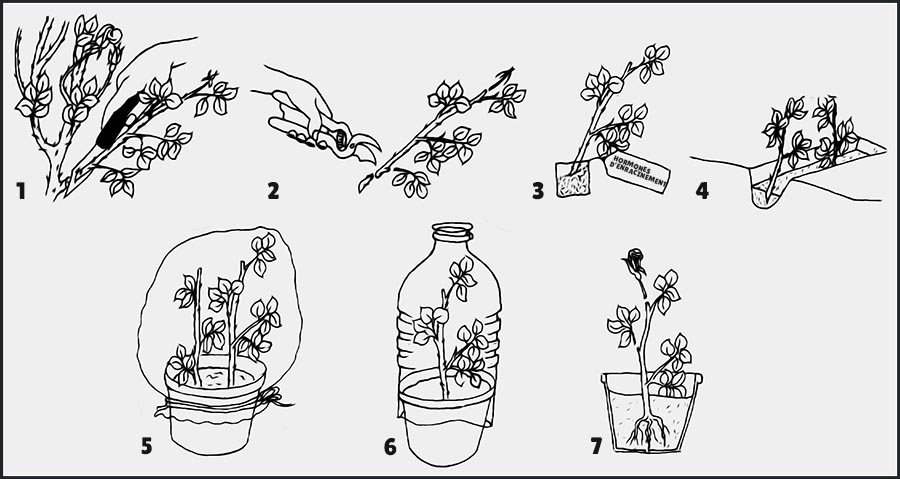
- 1. Rose cutting. Take very mature cuttings , that is, mature, if possible. Best time: September for regions north of the Loire, October for the south. Choose a very healthy and robust mother plant, because it would be absurd to propagate a variety susceptible to rose diseases or with few flowers. Cut cuttings with a knife or scissors, not pruning shears, on already flowering branches. They should be the width of a pencil.
- 2. Keep only the middle part of the branches with four or five leaves. Cut the two basal leaves, leaving two or three through which the cuttings can breathe.
- 3. Dip the base of the cuttings in rooting hormones , which will promote at least a 50% chance of healing. Shake to remove excess hormone powder.
- 4. Make a trench in the garden , in a semi-shaded and protected place; The trench should be 20 cm deep, about the depth of a shovel. Apply a 5cm layer of fine sand to the bottom for drainage. Prick the cuttings 12 to 15 cm apart and fill the trench with potting soil and peat moss (the latter retains moisture). Pack up and drink.
- 5. Variant: you can plant your cuttings in a pot, grouping them three by three in a fairly large container. To speed up recovery and recreate the microclimate of a greenhouse, cover the pot with transparent plastic: Condensation will permanently provide water, which is one of the keys to success.
- 6. Another method for potted cuttings: Plant each cutting individually in a pot with a diameter just smaller than a plastic bottle of mineral water. Cut one of them in half and use it as a bell.
- 7. Count one year before transplanting new cuttings . Remove the flowers so that the sap can concentrate when new shoots form.
With this pruning you get free-standing rose bushes, so they do not form stolons. This is an advantage… but it also has drawbacks; The roses obtained in this way are not usually very vigorous, especially in calcareous soils, where they offer little resistance and do not last as long.
Good to know: In very cold weather, cover with a plastic tunnel, frame, etc.
How to graft a rose?
Generally, grafting is not an amateur task. It is also the process by which professionals propagate roses. The principle is simple: on a rootstock, generally a rose hip, we place a graft of a variety that we want to propagate. With a little practice, you will definitely get the comb spread here.