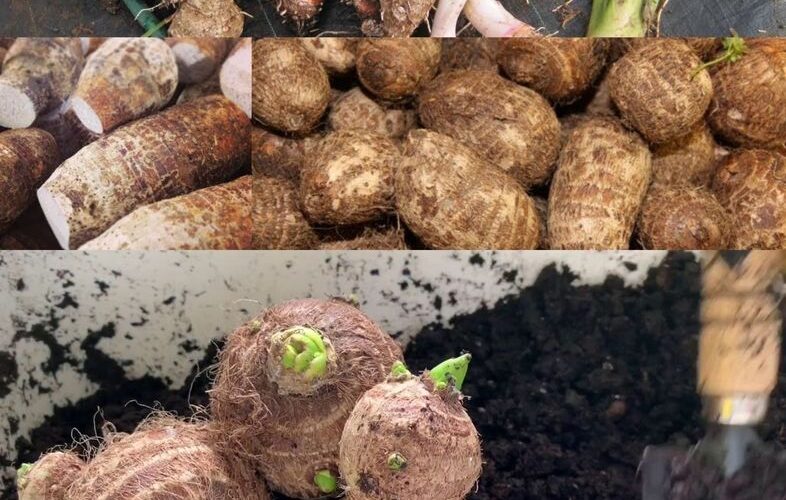
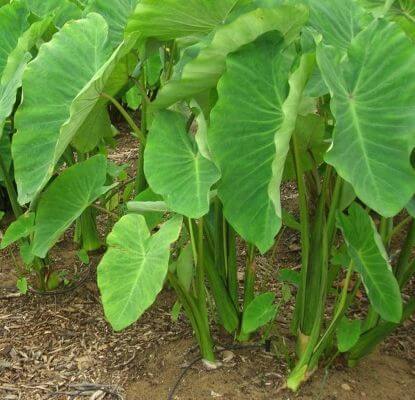
Today I will show you how to grow and harvest your own taro roots in your garden. The edible taro (Colocasia esculenta) usually grows in tropical regions, it is also called dream or madeira, it is a member of the Araceae family, a common name under which a large number of plants reside. In the family, there are many cultivars of edible taro varieties suitable for the garden. Sometimes called “elephant ears” because of the plant’s large leaves, taro is also called “dosheen.” This perennial plant of the tropical to subtropical region is cultivated for its food tuber.
The foliage can also be eaten when cooked like other green vegetables. It is rich in minerals and vitamins A, B and C. In the Caribbean, the green leaves are cooked extensively in a dish called callaloo. The tuber is cooked and purged into a paste, called poi, which was once a common staple in Hawaii. The starch in large tubers or globules of taro is highly digestible. It is a good source of carbohydrates and, to a lesser extent, potassium and protein. Edible taro is considered a staple crop in many countries, but especially in Asia. The most common variety used as a food source is Lugarsia esculenta.
How to grow and harvest Taro:
As mentioned, taro is tropical to subtropical, but if you don’t live in that climate, you can still try growing taro in a greenhouse. The large leaves grow up to 90cm to 1.80m tall, so space will still be needed. Additionally, patience will also be needed, as taro needs 7 months of warm weather to mature. To get an idea of how many plants to grow, 10-15 plants per person is a good average. The plant is easily propagated through tubers, which can be obtained at some nurseries or grocery stores, especially if you have access to an Asian market. Depending on the variety, the tubers can be smooth, round or rough and fibrous. Anyway,
Plant the tubers in furrows 15 cm deep and cover them with 5 cm of soil, space the tubers 40 to 60 cm apart in rows 1 m apart.
Regarding watering, you will need to keep the taro evenly moist. Taro is often grown in humid environments, similar to growing rice. Feed taro with a high-potassium organic fertilizer and compost. For an uninterrupted supply of taro, a second crop can be planted between the rows about 12 weeks before the first crop.
Harvesting of taro roots:
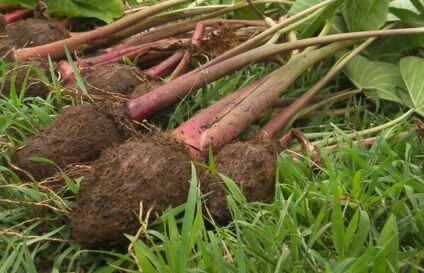
During the first week, you should notice a small green stalk spreading along the ground. Soon, the plant will grow into a bushy shrub that can grow up to 1.80 m tall, depending on the variety. As the plant grows, it will continue to produce shoots, leaves, and tubers that will allow you to continually harvest part of the plant without damaging it. The entire process takes around 200 days from planting the tubers to harvesting. To harvest taro corms (tubers), gently lift them from the ground with a garden fork just before the first fall frost.
The leaves can be collected as soon as the first leaves have opened. As long as you don’t cut off all the leaves, new ones will grow, providing a continuous supply of greens.