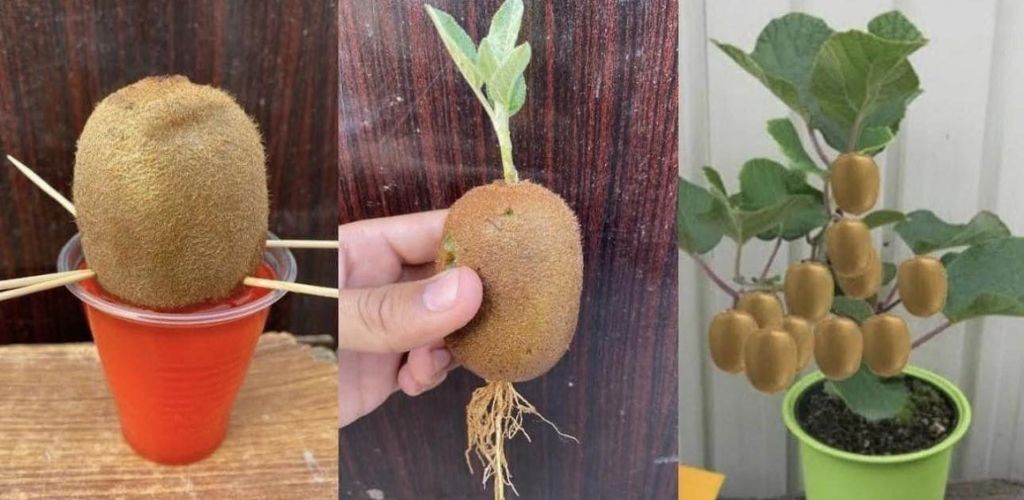
Kiwi is a fruit full of vitamins! In fact, just one kiwi is enough to obtain the recommended daily intake of vitamin C. Native to China, this climbing fruit plant is not afraid of cold or disease.
Kiwi (or Actinidia chinensis) can be male or female, so both plants should be planted together. There are self-fertile plants, but their yield will be much lower. The kiwi is a climbing plant with voluble and vigorous stems.
Growing it requires a little patience, but is still very simple to achieve. Follow this step-by-step guide to learn how to plant, grow, and harvest your kiwis!
1) What kiwi to plant?
You should know that kiwi needs at least one male plant and one female plant to grow. The ideal would be to plant two plants of each species to ensure pollination. One male plant is needed for three to five females at most. Small gardens can do with a self-fertile plant, but you will get very few kiwis.
2) When and where to plant kiwi?
Kiwi is planted in autumn, ideally at the end of September. The soil should be rich, light, well-drained and deep. It should remain cool, but kiwi also needs sun, so prefer a location in partial shade. Being a vigorous, climbing plant, grow it near a climbing plant structure such as a pergola (a tree trunk also works).
3) How to plant kiwi?
Dig the planting holes at least 50 cm wide and deep. This should be twice the size of the root ball being planted.
Space your feet 4 to 6 m apart.
Apply a well-decomposed organic fertilizer (compost).
Place the root ball in the middle of the hole and fill with compost.
Tamp well.
Water abundantly without drowning the roots.
4) Plant care
Kiwi fears drought. Make sure the soil is always moist. Water more when it’s hot and much less when it’s cold. Each fall, apply manure to each foot. In spring, opt for a special fertilizer for fruit trees. In winter, protect young plants from frost with a protective veil. Don’t forget to train the stems as they develop without crowding the twigs too much.
As for pruning, as long as the tree has not fruited, there is not much to do except balance everything.
In January, after fruiting, it is necessary to prune two eyes under each fruit cluster and remove branches that have fruited. In summer, it is necessary to pinch four-leaf shoots.
5) Harvest
Patience is the key to this crop, because you have to know that the kiwi will not bear fruit for about five years. Kiwi is harvested in summer before the first frost. Simply separate it from its stem by twisting it slightly. After about ten years, it is possible to harvest up to 30 kg of fruit per vine!