Dreaming of a lush and productive vegetable garden?
Do you want to grow your own vegetables, fruits, and aromatic herbs to enjoy their flavors and benefits on a daily basis?
Discover our best gardening tips to make your garden a success this year and get the most out of your harvest.
1. Choose the location of your garden carefully
To begin with, it is essential to choose the right location for your vegetable garden.
READ: What to sow and plant in July in the garden?
This will have a direct impact on the growth and health of your plants. Here are some criteria to consider:
– Sun: Most vegetables, fruits, and aromatic herbs need a lot of sun to grow properly. That’s why it’s important to choose a sunny spot, with at least 6 hours of sunshine a day.
– Proximity to water: to facilitate the watering of your plants, it is best to choose a location close to a water source (tap, rainwater collector, etc.). This will save you from having to go back and forth with watering cans or garden hoses.
– Soil quality: Soil quality is also an important criterion to consider. A soil rich in organic matter and well drained will promote the growth of your plants. If your soil is poor or too compact, you can improve it by adding compost, manure, or natural fertilizers.
– Wind protection: Finally, it is preferable to choose a location protected from strong winds, which can damage your plants and limit their growth. To do this, you can plant a hedge or install a windbreak.
2. Prepare the soil for your vegetable garden
Once you’ve chosen the location of your garden, it’s time to prepare the soil.
This step is crucial to ensure good growth of your plants. Follow these tips for fertile, well-drained soil:
– Loosen the soil: before you start planting, it is important to loosen the soil to a depth of at least 20 cm. This will allow the roots of your plants to establish easily and attract the nutrients they need. You can use a shovel, paddle fork, or rudder to turn the soil.
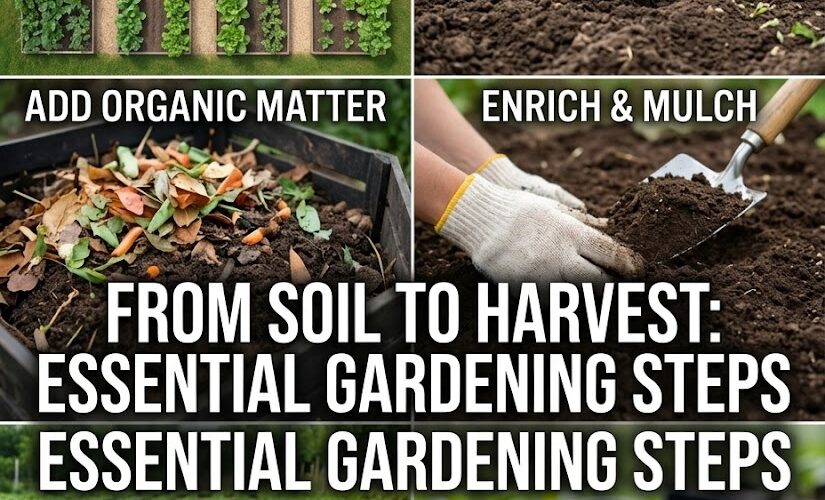
– Enrich the soil: to promote the growth of your plants, it is important to add organic matter to your soil. You can use compost, manure, or natural fertilizers to enrich the soil. Spread these amendments on the surface of the soil, then incorporate them by turning the soil over.
– Improve drainage: well-drained soil is essential to prevent water from stagnating and causing rot or disease problems. If your soil is too compact or clayey, you can add sand, gravel, or pine bark to improve its drainage.
– Practice crop rotation: to preserve the fertility of your soil and limit diseases, it is important to practice crop rotation. Change the location of your vegetables every year, following a 3- or 4-year cycle. For example, you can plant legumes (beans, peas) after nightshades (tomatoes, eggplant), then cruciferous (cabbage, broccoli), and finally alliums (onions, garlic).
3. Select the right plant varieties
To make your garden a success, choose varieties of plants adapted to your climate, your soil and your needs.
Here are some tips for making the right choices:
– Favor local varieties: To maximize your chances of success, opt for local varieties of plants, which are best suited to the climatic and soil conditions of your region. Consult with experienced gardeners or nurseries to find out which varieties are best suited to your situation.
– Choose hardy varieties: Certain varieties of plants are more resistant to diseases, parasites, and harsh weather conditions. Choose these varieties to limit treatments and crop losses.
– Vary the species and families of plants: for a balanced and productive vegetable garden, it is important to grow a wide variety of plants. This limits disease and parasite problems, and provides a favorable ecosystem for auxiliaries (beneficial insects, birds, etc.) that will help you fight pests naturally.
– Consider the growing schedule: Finally, it is important to plant your vegetables, fruits and aromatic herbs at the right time, respecting their growing schedule. Find out the planting, planting, and harvesting periods for each plant, and adjust them according to the weather conditions in your region.
4. Adopt good gardening practices
To make your garden a success, adopt gardening practices that respect the environment and promote the growth of your plants.
Here are some tips to implement:
– Water wisely: to avoid wasting water and promoting diseases, it is important to water your plants in a reasoned way. Instead, water in the morning or evening, when temperatures are cooler and evaporation is lower. Prefer to water at the foot of the plants, to limit moisture in the foliage. Finally, it adapts the frequency and quantity of water according to the needs of each plant and the climatic conditions.
– Mulching the soil: mulching is a very useful technique to protect and enrich the soil in your garden. It helps retain moisture, regulate soil temperature, limit weed growth, and add organic matter. You can use different materials to cover your vegetable garden: straw, grass clippings, dead leaves, pine bark, etc.
– Practice mound cultivation: Mound cultivation is an interesting technique to improve the drainage and fertility of your soil. It consists of creating raised mounds of earth, in which you will plant your vegetables, fruits and aromatic herbs. This technique also facilitates tillage and limits disease and pest problems.
– Companion plants: Certain plants protect and stimulate each other when grown together. This technique, called “companionship”, allows you to limit the use of chemical treatments and optimize the space of your garden. For example, you can combine tomatoes with marigolds to repel aphids, or carrots with leeks to control carrot fly.
5. Anticipate and manage disease and pest issues
Finally, to make your vegetable garden a success, regularly monitor your plants and act quickly in case of disease or pest problems.
Here are some tips to prevent and treat them:
– Inspect your plants daily: To quickly detect disease or pest problems, regularly inspect your plants, especially their foliage, stems, and fruits. If you notice unusual signs (spots, deformations, the presence of insects, etc.), identify the problem and act accordingly.
– Favours natural treatments: to fight diseases and parasites, favours natural treatments that respect the environment. Vegetable fertilizers (nettle, horsetail, comfrey), essential oils, natural insecticides (black soap, pyrethrum) or preparations based on baking soda or milk can be used.
– Attract beneficial ones: to combat pests naturally, it is important to attract beneficial ones (beneficial insects, birds, etc.) to your vegetable garden. To do this, you can plant honey flowers, install nest boxes, insect shelters or water points.
– Respect the rules of organic farming: finally, to preserve the health of your plants and your soil, it is important to respect the rules of organic farming. Avoid the use of pesticides and chemical fertilizers, prefer landraces and hardy varieties, and practice crop rotation.
By following these tips and tricks, you’ll put the odds on your side for a successful vegetable garden this year and get the most out of your harvest. Don’t forget that gardening is an art that is learned and perfected over time: be patient, persevering and curious, and enjoy the fruits of your labor! Happy gardening!