
Hydrangeas are wonderful, explosive flowers. They are known to be ball-shaped and have many petals. Hydrangeas can also come in different colors. Pink, blue, purple, white, etc.
In this article we will see how to care for this wonderful plant.
What to Do When Planting a Hydrangea
The hydrangea, especially if it is still very young, loves to be watered regularly during its first year of life. In summer it is also possible to water it more than once a day. It is enough that the operation is carried out carefully.
From the beginning of the hot season, from the month of June, we can water the hydrangea daily with an amount of water around 5/8 litres per specimen, especially in case of drought. But while hydrangea loves to be watered, water isn’t the ultimate solution for excessive sun exposure , because the flowers would dry out quickly.
Hydrangeas love the sun, but not prolonged exposure to direct light. In fact, this beautiful plant should only be exposed for a few hours a day, otherwise we would risk burning the leaves and petals.
When to prune a hydrangea
Pruning operations should be carried out in early spring. It is necessary to cut all the oldest branches and those that are worn and weak. However, it is not advisable to cut the branches starting from the base, because we could compromise the subsequent flowering. .
To make hydrangea strong, it is necessary to cut off about a third of the old fronds to provoke the stimulation that produces new branches.
Fertilizing Hydrangea
Since hydrangeas bloom between spring and summer, they can be strengthened with a specific fertilizer. The most suitable product is that of slow-release acidophilic plants. and it can be administered from the beginning of spring in correspondence with the month of March.
If hydrangea is planted in soil that has characteristics of neutrality or alkalinity, it should be treated with specific iron sulfate-based products between late winter and early spring. Keep in mind, however, that sometimes iron is not absorbed by the plant or that the leaves begin to show signs of chlorosis. This is a pathological condition that can compromise both foliage and flowering.
Growing Hydrangeas in Pots
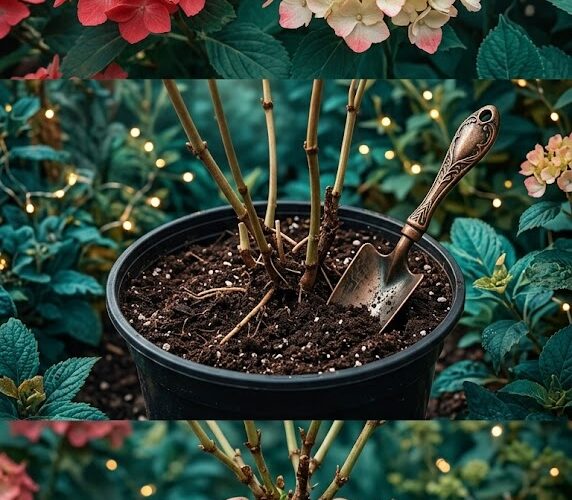
Hydrangea is a type of shrub that fits both in the garden and in pots at home. And even in this case, inside the house, the rules must be followed to keep it exuberant. The pots to house the hydrangeas should be spacious and should be placed in airy spaces, so as to ensure regularity, regular and splendid flowering.
Even indoors, hydrangeas need a sunny, nutrient-rich watering and fertilizing location to ensure their longevity and flowering.
Hydrangeas are robust plants, they can even withstand frost, but they cannot withstand heat. The ideal temperature for its growth is around 18 degrees.
If you want to grow hydrangeas at home, simply place the vase near a window, but away from heat sources.