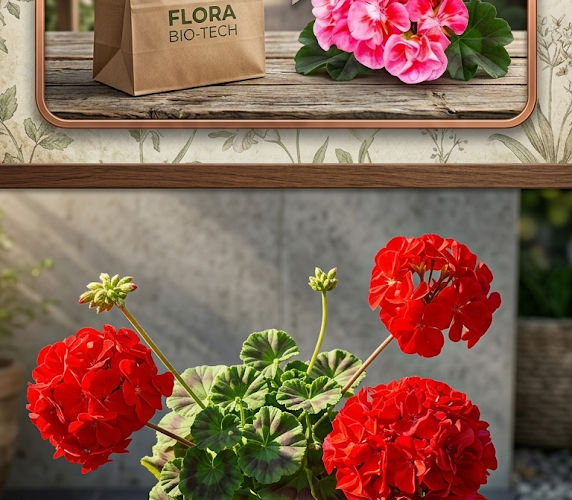

Geraniums are well-loved for their abundant and colorful flowers, but how are they grown? It is an ornamental plant that needs little care and of which you can find many different varieties: whether you decide to plant it in soil or in a pot, perhaps on your balcony, a little attention will be enough for it to produce many flowers. and avoid some of the most common problems, such as yellow leaves.
The geranium is a very common ornamental plant for the decoration of balconies, terraces and gardens, appreciated for its abundant flowering and variety of colors. Geraniums are easy to grow, both in pots and in the ground, and require little care. They love mild Mediterranean temperatures, between 15 and 25 ºC, while they tolerate very hot summers with difficulty and, although they are among the cold-hardy plants, they also suffer from overly harsh winters. Some varieties, typical of southern Italy, prefer direct sun, while those typical of mountainous areas should be kept in the shade.
In any case, a few precautions are enough to have beautiful and leafy geraniums, such as using fresh and fertile soil, choosing the right pot, the best time to plant and prune them and the right location. Let’s take a better look at how to grow geraniums in pots.
When to Plant Geraniums in Pots
The best time to plant geraniums in pots is spring, when the temperature ranges between 15 and 25 ºC. Propagating geranium by cuttings is the simplest way, just cut a few twigs from the sturdiest shoots, immediately after the knot, preferably with a sharp knife, to prevent fraying. The cutting should then be buried and the pot should be protected with cling film to create a warm, moist environment. No rooting hormones are needed.
If you buy a geranium seedling, however, first of all we have to remove it from the small pot in which it is planted, because it does not allow the roots to grow and the plant to germinate. In the new pot, which should be larger than the previous one, put a first layer of expanded clay at the bottom to promote natural drainage, then a layer of soil and then the seedling, making it adhere well. We add more soil until we leave a few centimeters from the edge of the pot and then press gently to compact everything. Finally, with your hands, remove the yellow leaves and dried flowers.
Variety
There are about four hundred species of geraniums and many varieties, with erect or hanging stems, but above all of many different colors: you can find them yellow, red, white, pink, lilac or orange , to name just a few shades. To decorate balconies and terraces, the ideal is to mix several colors according to your tastes. Of course, you have to take into account the temperatures of the area where we live, if we want lush flowers.
Returning to the varieties, I will list here some of the most well-known and appreciated types of geraniums:
- Geranium ivy : also called Pelargonium peltatum or Parisian geranium, it is a climbing variety that has shiny leaves and is able to withstand drought more, a characteristic that makes it suitable even for warmer areas. It can produce very abundant flowers and its tendrils can reach up to a meter and a half in length.
- Imperial Geranium: Pelargonium grandiflorum, also known as royal geranium, comes from Africa and therefore grows best in areas with temperatures between 20 and 25 degrees. It has an upright bearing and its flowers are large and very intensely coloured. If you decide to grow it outdoors, place it in a sunny location but be careful to protect it from the wind.
- Scented geranium: Pelargonium odoratissimum also has African origins and has become popular thanks to an unusual characteristic, namely the particular velvety leaves with an intense aroma, which can also repel mosquitoes. On the contrary, it is a variety that does not offer great blooms.
- Zonal geranium – is one of the most common varieties of geranium, which produces many flowers during the summer and is distinguished by the presence of a darker zone (or zone, in fact) in the center of the leaves.
How to Grow Geraniums in Pots
Geraniums adapt well to any type of soil, as long as they are fresh and fertile, preferably with a substrate of peat moss and clay soil. It is also important to ensure proper water drainage to prevent root rot. The ideal time to transplant is spring.
Before transplanting the seedling, it should be watered thoroughly and the roots should be cut too long or knotted. The pot should be placed in an airy place, but not too exposed to strong drafts, in the sun or in partial shade.
The pot should not be too small, because it would prevent the roots from growing properly, but also not too big, because the roots would expand too much, to the detriment of the flowers and leaves.
Treatment
In summer, geraniums should be watered frequently, but only when the soil is completely dry, to avoid water stagnation that could cause root rot. In winter, on the other hand, it is only advisable to water them sporadically. During the cold season they should be kept sheltered from frost, in a covered and sheltered corner of the balcony, or at home, but away from radiators and fireplaces. Watering should be completely suspended in case of frost and snow, because they would freeze the ground.
For flowering, it is important to turn the topsoil from time to time and use a liquid fertilizer with potassium. However, we should not overdo it with fertilization, which should only be done between February and March. To prevent the flowers from fading, the plants should not be exposed to direct sunlight.
As for pruning, yellowish leaves and dried flowers should be cut to promote regrowth and avoid the appearance of diseases. Also pay attention to the foliage, which can give you important information about the health of your geraniums. For example, if the plant has yellow leaves, it may be the result of overwatering or exposure to a place that is too wet, so it will be better to stop watering first. The same problem can be caused by the use of water that is too cold or by drafts, also at low temperatures. If, on the other hand, the leaves turn yellow due to lack of nutrients, you will have to solve it by using a Business Suit fertilizer.
It can also happen that your geraniums develop red leaves, usually due to some kind of stress : most of the time the problem depends on temperatures that are too cold, so you will have to move the plants to a warmer place. Alternatively, you may have overwatered the potting soil, or conversely left it dry for too long.