Keeping knives and scissors sharp is essential in any home. However, many people believe that to achieve this it is necessary to buy special tools or take them to a professional. The reality is that there is a very simple method that can help you regain the sharpness using something that almost all of us have in the kitchen: aluminum foil.
This homemade trick is quick, inexpensive, and surprisingly effective. In just a few minutes, you can significantly improve the sharpness of your tools without spending money or using complicated equipment.
Next, you’ll learn step-by-step how to sharpen scissors and knives using just a piece of aluminum foil.
How to sharpen scissors with aluminum foil
Scissors often lose their sharpness over time, especially if they are used to cut thick or hard materials. With this simple method, you can give them back much of their cutting capacity.
Step 1: Prepare the Foil
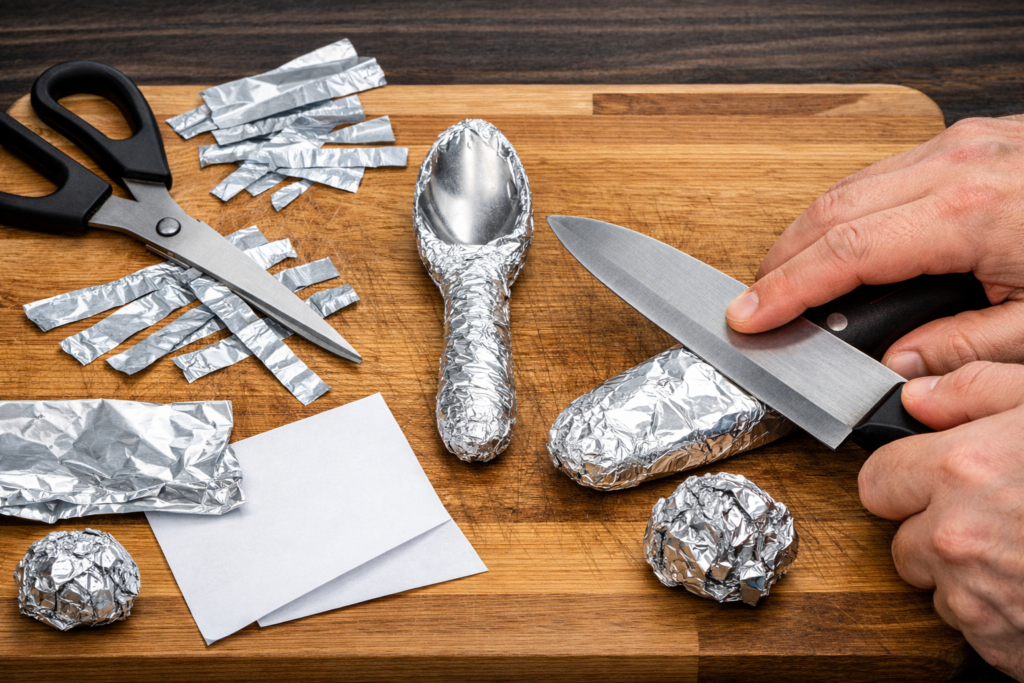
Cut a small piece of aluminum foil. It doesn’t matter if it’s a little wrinkled or has some torn parts.
Then fold it over a few times until you get a thick piece, about the size of a matchbox. The more layers you have, the better the sharpening process will work.
Step 2: Start Cutting
Take the scissors and start cutting the foil calmly.
Make cuts into small strips about half a centimeter or one centimeter wide. No need to rush; the important thing is that the cut is continuous.
Step 3: Cut from both sides
Once you’ve made several cuts, twist the foil and repeat the process from the other side.
This movement helps the scissor blades to come into contact with the aluminum from different angles, which helps to improve the sharpness.
Step 4: Repeat the process
Fold the foil again to make it thicker and cut again.
Try starting a few cuts from the tip of the scissors and then working your way to the base. This is important because the tip is usually the part that loses the sharpest edge.
After several cuts you will notice that the scissors begin to go through the aluminum more easily.
Step 5: Check the result
To check the result, cut a sheet of paper.
If the scissors were dull, they probably only crumpled the paper before. They should now glide much smoother and cut precisely.
The whole process can take as little as two or three minutes.
How to Sharpen a Knife with Aluminum Foil and a Spoon
This second trick is equally simple and uses a spoon as a support for the process.
Step 1: Prepare the Aluminum
Take a piece of aluminum foil similar to the one you used with the scissors.
Fold it several times until it forms a small thick rectangle.
Step 2: Wrap a Spoon
Place a spoon inside the foil and wrap it completely.
It is important that the aluminum covers the entire surface well to prevent the spoon from being exposed.
Press with your fingers so that the paper is tight and firm around the spoon.
Step 3: Run the knife through the aluminum
Rest the handle of the spoon against a kitchen board or a firm surface.
Then run the knife over the aluminum at an angle of approximately 25 to 30 degrees.
Make gentle movements from the tip of the knife to the base of the edge. It is important that the entire sheet passes through the aluminum.
Do this movement several times.
Step 4: Repeat on the Other Side
After a few movements, turn the knife and repeat the process on the other side of the edge.
This step allows you to balance the sharpening on both sides of the blade.
Step 5: Remove Minor Imperfections
After several movements, a small burr may appear on the edge of the knife.
To remove it, place the knife straight on the aluminum and make a few gentle movements back and forth without pressing.
This helps to smooth the edge.
Step 6: Finish with an aluminum ball
Remove the foil from the spoon and form the remains into a small ball.
Now make gentle movements as if you were cutting bread or sausage.
Do this for about 30 seconds.
This final step helps polish the edge of the knife.
Tips and recommendations
- Always perform the movements calmly to avoid accidents.
- Keep the knife at a constant angle for best results.
- If the scissors are very dull, you can repeat the process twice.
- Use a kitchen board or firm surface to work more safely.
- Wash and dry the knife thoroughly after the process to remove aluminum residue.
- Never make sudden movements or exert too much pressure.
Sharpening knives and scissors doesn’t have to be complicated or expensive. With a simple piece of aluminum foil and a few minutes of patience it is possible to significantly improve the sharpness of these tools. This home method shows that, many times, the simplest solutions are also the most effective to solve everyday problems at home.